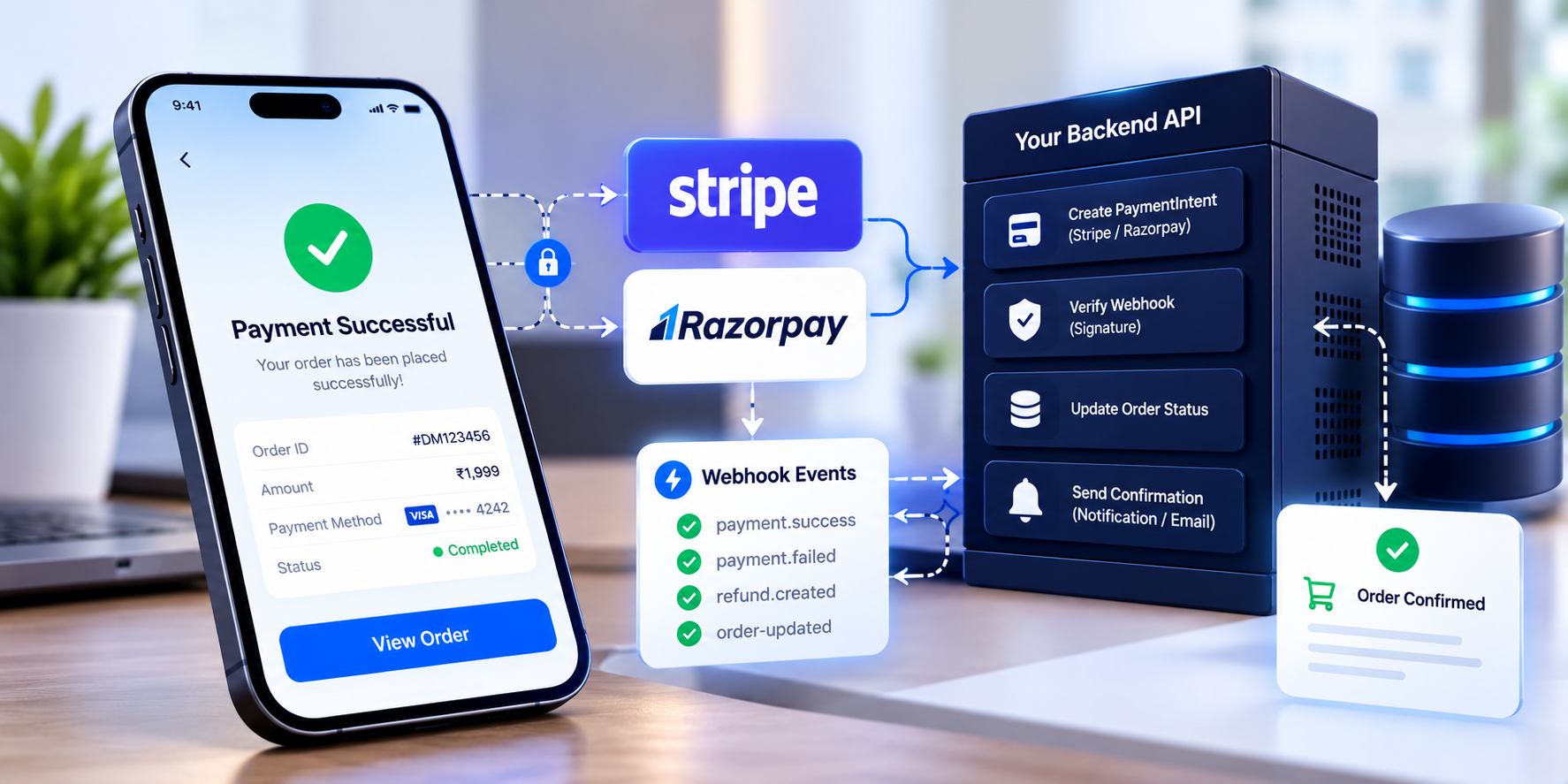
Mobile Payment Gateway Architecture: Stripe & Razorpay Best Practices
Never calculate order prices or finalize orders on the mobile device. The backend must generate PaymentIntents and verify webhook events.
Why This Matters
Prevents client-side payment tampering and guarantees PCI-DSS compliance.
Core Concepts & Architecture
The mobile client only collects tokenized payment details; the server authorizes and captures funds via signed webhooks.
Implementation Details
Stripe PaymentSheet and Razorpay Standard Checkout SDKs with 3DS2 automated challenge flows.
Practical Code Example
The following code illustrates this pattern in a production-ready implementation:
import { useStripe } from '@stripe/stripe-react-native';

export function CheckoutButton({ clientSecret }: { clientSecret: string }) {
  const { initPaymentSheet, presentPaymentSheet } = useStripe();

  const handlePay = async () => {
    await initPaymentSheet({ paymentIntentClientSecret: clientSecret, merchantDisplayName: 'DevMinds' });
    const { error } = await presentPaymentSheet();
    if (!error) console.log('Payment authorized on device!');
  };

  return <Button title="Pay Securely" onPress={handlePay} />;
}
Production Considerations
When deploying this in production environments:
- Enforce strict typing and runtime schema validation on all public ingestion vectors.
- Implement defensive rate limiting, connection pooling, and graceful process shutdown.
- Monitor execution latencies using structured telemetry, APM traces, and health check endpoints.
Performance, Security & Scalability
- Security & Authorization: Validate inputs, sanitize database queries, and maintain strict access boundaries.
- Scalability: Design for stateless horizontal scaling and leverage connection pooling and edge caching.
- Telemetry: Track P95 and P99 latency percentiles to detect regressions early in staging.
Common Mistakes & Best Practices
Common Mistakes
- Neglecting Edge Case Validation: Failing to handle network partitions or invalid payloads gracefully.
- Hardcoding Configuration: Always inject environment variables and avoid magic constants in domain code.
Best Practices
- Idempotency: Guarantee safe retries on state-mutating operations.
- Automated CI/CD: Run regression test suites in isolated branches before cutting over production traffic.
Conclusion
Two-step payment verification: Initializing PaymentSheet on device and settling orders via webhooks.
Building a modern mobile or web product? Discuss your upcoming project with our software engineering team at DevMinds Technologies.
Sources & References
- Stripe React Native Official Docs (Official Documentation)