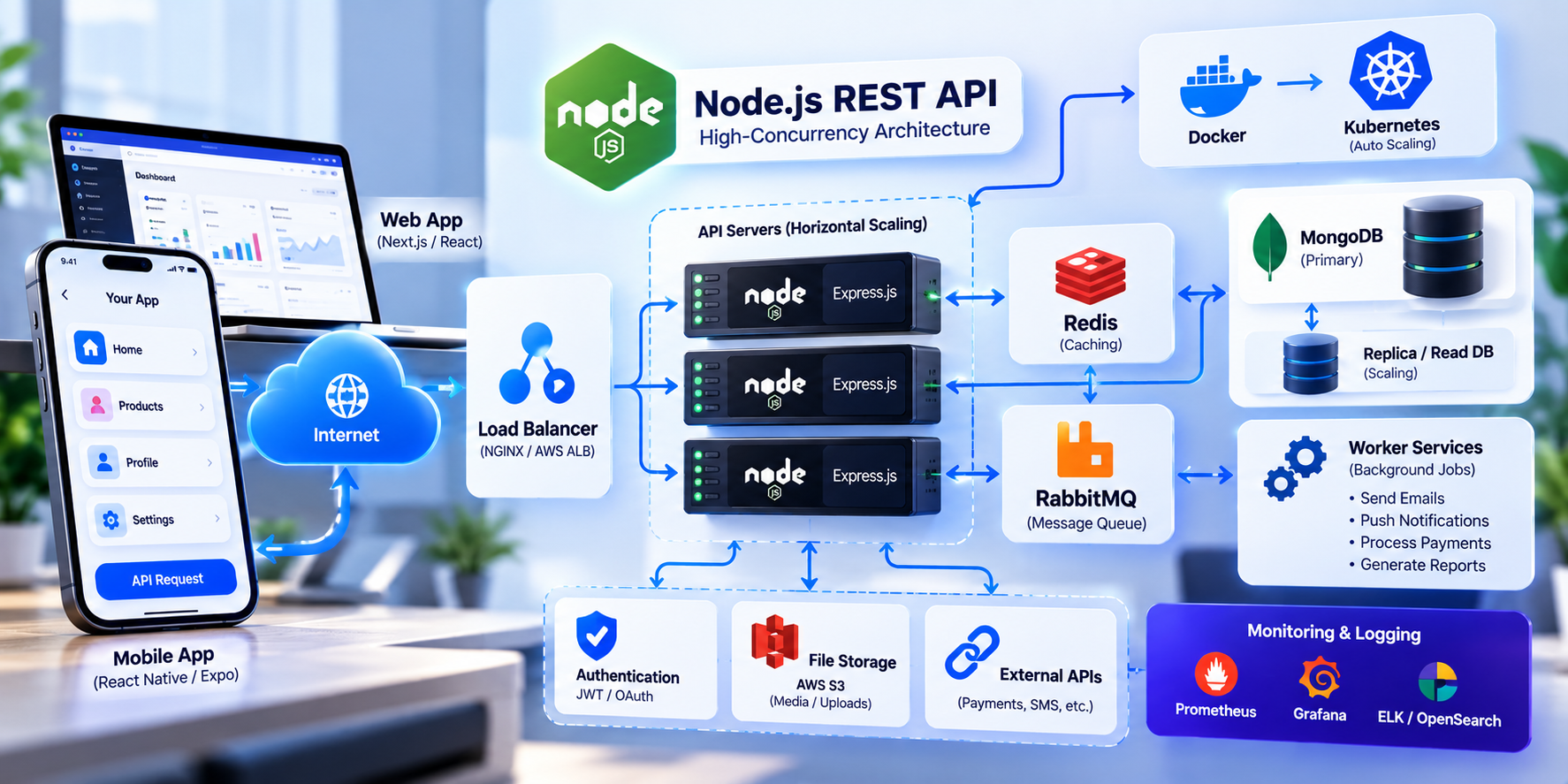
When scaling backend services to handle thousands of concurrent requests, modular architecture and defensive engineering are non-negotiable.
The Three-Tier Architecture
To isolate business logic from transport protocols, every backend service at DevMinds follows strict domain tiers:
- Routes & Middleware Tier: Handles routing, rate limiting, CORS, and request authentication.
- Controller Tier: Validates schema inputs, orchestrates service invocations, and maps HTTP status codes.
- Service & Repository Tier: Encapsulates core business transactions, database queries, and external cloud integrations.
// controller.ts
export const createOrder = async (req: Request, res: Response): Promise<void> => {
  const { items, customerId } = req.body;
  const order = await orderService.processCheckout(customerId, items);
  res.status(201).json({ success: true, data: order });
};
Graceful Process Shutdown
A production application must never drop active HTTP requests when scaling or redeploying:
const gracefulShutdown = (signal: string) => {
  server.close(async () => {
    await mongoose.connection.close();
    process.exit(0);
  });
};

process.on('SIGTERM', () => gracefulShutdown('SIGTERM'));
Defensive Security Guardrails
Always incorporate NoSQL parameter sanitization, rate limiters, Helmet headers, and schema validators on all public ingestion vectors.